Monday, September 22, 2008

Travels through Normandy – Paris

Sooo, quick recap, we’ve ferried to La Havre, driven to Bayeux, Mont St Michel and Arromanches, seen almost everything there is to see, and eaten all the delicious French food we could (in restaurants and by the side of the road!). However, the Johnstone’s are not done with Normandy yet. Once we have been given a stiff dose of reality at Arromanches, we set off for Vernon.

Vernon is a beautiful, medieval town in Eastern Normandy. Well, let’s be honest, pretty much every town we have visited so far has been medieval, with original buildings, narrow streets and tons of atmosphere. We get to the center of Vernon, and find our hotel. It’s no Hotel Tardif (impossibly welcoming), but it has beds, a distinct improvement over some of the places I have visited. We arrive in the afternoon, and we are all ready for naps and refreshments. Over the past few days, we have made a habit of spending our early evenings (before we go to dinner) chatting with Mum & Dad over drinks. It is a great way to relax, review the happenings of the day, and make dinner plans.
The next day, Friday, we have breakfast and go straight to the station. Dad bought our train tickets the prior evening, and we are on the 8:45 train. It’s only a 45 minute ride to Paris St Lazare.

At our destination we board the metro and it’s off to the first stop of the day, The Eiffel Tower. Megan, Dad and I walk up to the first floor, and then take the lift to the second. Check out those photo’s, that’s the Seine behind us, pretty cool, eh?

Next, boat tours on the Seine, passing under some fabulous bridges, and drifting by buildings you only read about, or see in movies. The term “living history” comes to mind. Here we are, experiencing history, in all it’s architectural splendor. Thinking about it now, I can realize the big picture of this city. Each part of our day has built the complete picture, created by imaginations that knew no limits. What will our great grandchildren say about the buildings we leave behind? How will the architects of our generation leave their mark? As I think on it, it becomes more and more clear, that our neighborhoods, towns and cities are built in a far more disposable fashion.

Notre Dame is our next landmark, but first we stop for a quick lunch, and then it’s off to the Latin Quarter. It’s on the way to Notre Dame, and it makes for a nice interlude to all the rushing around we are doing. It also really deserves a few hours, as the potential to wonder little side streets and get lost in the culture is almost irresistible. In France, everything is made for your viewing pleasure, food, buildings, clothes, art, etc. Passing by charcouteries, you can see terrines that are simply beautiful. Patisserie windows are filled with desserts (large and small) that look too pretty to eat (however, once they are in your hand, it becomes that much easier!). Even the butchers (boucherie) shop makes the meat look ultra appetizing, and it’s not even cooked yet.

Back to Notre Dame (sorry, I am easily sidetracked), our next stop. What can I say; it’s a really big church! Let me explain, one of the keys of French architecture (especially French religious architecture) is that it is all completely over the top – so, yeah, it’s a really big church, but it’s so much more than that.

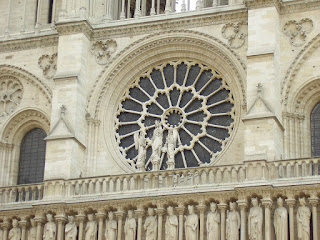


Take a look at these pictures, at the entrances (each arch is decorated in multiple layers), all the statues, and that rose window, another predominant feature in French churches.


Unfortunately, we don’t have time to hang around for too long, just long enough to sit, appreciate the features of Notre Dame, and then it’s time for The Louvre. Back on the metro, and we come out directly across from our destination. I will warn you know, I don’t know that I have words for this, cause it is really, really spectacular. The Louvre was the residence (read “palace”) of the royal family before Versailles was completed. Walking into the courtyard, we pass through a carriage way, and it’s not hard to imagine the ‘clip, clop’ of horses hooves as they pull a carriage. Of course, all we can hear now is the footsteps of hundreds of tourists, but remember, you are walking in the footsteps of history.


Entering the courtyard is by far, the best experience ever.


The building is built in a U shape, around this courtyard. New additions include fountains, reflecting pools and of course, the famous glass pyramids.


What an incredible comparison of classic and contemporary, and on such a massive scale. The contemporary is made that much more real by the atmosphere. People are everywhere, talking, laughing, reading, pondering, and being themselves. People from all walks of life, speaking every language, taking a moment to appreciate their surroundings. This scene perfectly represents (and complements) the spirit of art, and the expression of artists through the ages. Some may want to push the boundaries, and develop scenes that challenge the way we think about and view the world around us, others want to depict the beauty they see in the world around them, whether it is the curve of a flower petal, the curve of a baby’s smiling cheek, or the curve of a comforting arm. Just as these people represent all walks of life, art depicts aspects of life, love, loss, anger, pain, beauty, joy, feelings, thoughts and emotions that no full life is without.

Yes, it's true, you cannot fully appreciate the joy and happiness of life without also experiencing the pain and tragedy. But, when the happiness, pain, joy and tragedy of life is experienced with the three people below, then I say "Bring it on", cause they make it all worth while.


All of this takes us to our final destination, Sacre Couer, built on the summit of the butte Montmartre. It is reputed to be dedicated the lives of 58,000 soldiers (hence it’s name Sacred Heart), who lost their lives in the year long, Franco-Prussian war. In reality, the request to build this basilica, made by the archbishop of Paris, specifies it is to “expiate the crimes of the communards”.


Er, no, not the Communards, 80’s band (singers of “Don’t leave me this way” & “Why?”), but the communards, members of the Paris Commune, a government that briefly ruled Paris in 1871. The Paris Commune were basically democratic socialists (without getting too deeply political), and I think we all know how the Catholic Church feels about free thinking lefties! Really want to know more (cause there is more, I promise, and my understanding is merely that, my limited understanding), then check out this link Basilique du Sacré-Cœur, Paris, & Basilique du Sacré Coeur. Ultimately, it is another really big church, but this one is definitely finished on a much grander scale than Notre Dame, and the whole effect, built on a summit, white stone, with multiple elevations and styles, it really is breathtaking.


Whew, ok, so I have finally finished up Paris! Gotta start writing about Giverny, thank goodness for notebooks and Google!

Tuesday, August 5, 2008

Travels through Normandy – Arromanches

After two nights in the wonderful Hotel Tardif in Bayeux, it was time to leave. We had visited Bayeux and Mont St Michel, and now we were headed to Vernon, in Eastern Normandy. Vernon was to be our base of operations, from whence we should visit Paris and Giverny, but more about that later.

This posting shall be dedicated only to Arromanches, and, in spirit, dedicated to the brave troops who landed on the beaches of Normandy in June 1944. We don’t think much of it today, but it is an important part of our history. When I say “our”, I mean mine as a Brit and yours as an American.

Before we get started, lets get one thing completely clear, we are talking about the Allied Forces, both British and American troops (although they landed separately), and now would not be the time to remind me that “us American’s saved your ass in the war”.

A failed raid in 1942 taught the War Office that if they wanted to land “we must take our harbors with us”. Prefabricated ports were developed that consisted of breakwaters, pier-heads and floating piers. These portable harbors were given the code name Mulberry.

Arromanches was the landing point for Mulberry B (Mulberry A went to Omaha Beach, where the American troops landed). The pieces were floated across the channel, and then sunk to create the artificial harbor. (Wait, lets think about that for a minute, the Germans are flying over the Channel nightly, for bombing raids on the UK, and the Allies are floating bloody great barges across the channel, at around 6MPH – talk about taking your life in your hands!) Today, remains of these Mulberries can still be seen in Arromanches. The guidebook tells us they make for a startling sight, but really, they are a testament to the ingenuity of mankind, in a desperate time, taking desperate measures.

The truly startling sight is the Arromanches 360. Located on the cliffs above the beaches (Sword, Gold and Juno), is a monument to the regiments who landed, and a theatre, which shows the movie “The Price of Freedom”. The movie is shown on 9 screens, in 360 degrees. No one sits down; you lean on a horizontal bar behind you. The theatre is crowded with people of all nationalities. No translation of the movie is needed, as there is no narration, and no dialogue. The entire movie uses wartime footage of the landings, Arromanches, and battle damage, and joins it with footage taken 50 years later. In one amazing scene, a local bridge is shown, one screen shows one side of the bridge as we see it today, the next screen shows wartime footage of the center of the bridge, the next screen shows the other side of the bridge as we see it today. But that is just fancy imagery. The truly startling part is the smiling men on the landing craft, laughing and smoking. They are having a blast. Brave or scared, they are going into the unknown, with little or no idea of the incredible battle and losses they are about to face. Next we see images of the beach, fallen men, dead or injured we don’t know. Next there are images of the beach today, peaceful, children playing in the sand and the sea. Images of a bombed out town come next, civilians (having been allowed back in) are combing through the rubble; a lone kitten stands in the ruins of a street. Then gunshots, soldiers searching houses. Then color images of those streets today, a market, a couple walking hand in hand, and their child running ahead of them. The town has been rebuilt, through the love, commitment and solidarity of the townspeople. This brings to mind the French revolutionary statement “Liberte, Egalite, Fraternite” – Liberty, Equality, and Brotherhood.

More images of the sick and wounded, housed in mobile hospitals, as their comrades fight on. These soldiers traveled on foot, from town to town, fighting for freedom from one house to another. And I don’t use that term for any kind of imagery; they literally fought from one house to another. Never have I been so moved by the mere image or thought of what freedom meant to a person, or what it means to me. I sit here, in my parents home, looking at the gray weather outside, and not once do I think “Will it be safe to go into Chichester today?” or “Will it be safe to travel home on Thursday?” however, I know that people think about these things every day (well, not in the terms of going into Chichester, but their local equivalent, Chichester is perfectly safe).

I should say here, that I am a ‘live and let live’ kind of person, not one to judge others on their way of life, or how they choose to live it, (unless it is harmful to others). I don’t care if you want to wear a burkah; I just think you should be given the choice. I don’t care if you want to practice another religion; I just want you to have the choice. I just want us all to be happy, and live in a society where we are free to choose. And, if the society does not allow you to choose, or you feel oppressed, speak up; don’t stay quiet, as history has shown us what staying quiet can do.

~I'm putting a photo of Megan here, because her middle name is Laurel, a symbol of victory~


Ok, so, off my soapbox – sorry! In my prior post about Bayeux and William the Conqueror, I made sure to tell you that the battle between William and Harold was over in 8 hours, just another day at the office. The Germans were so entrenched in France, that it took the troops 34 days to reach Caen, which is only 22 miles away. Of course, you realize that it didn’t take them so long cause they were slow walkers, or just dilly-dallying along the way. It took them 34 days cause they fought from house to house, in each village or small farming area they came across. And each day, they did it again, and again, and again. Through all this fighting and bombing, there were agreements as to which towns would be spared (seriously!). Paris was one of them, Bayeux was another.

That is about it for our history lesson for today, just one last point to discuss. The French often get a bad rap for giving in so easily to the Germans, for “handing over” their country, for being traitors, as it were. However, this is an over simplification of a more complex issue. Prior to the WWII, France had been through The Great War (1914-1918). They had suffered huge losses. What does this mean for the German invasion in WWII? It means the French lost an entire generation, or, that a generation of troops that should have been born and raised between 1918 and 1940 just didn’t happen. With far fewer men of fighting age, the French were at a disadvantage when the Germans arrived.

~A photo of my parents here, cause they are wicked cute sometimes, and the structure behind them represents what my mother's father worked on during the war.~


Alright, I am done for today. Next on the agenda, the beautiful town of Vernon, Paris and Giverny, home of Claude Monet.

Saturday, August 2, 2008

Bloody English Weather!

Take a look at the photo below - 9:30AM, when my Dad and I were considering going racing in his boat. Since it was gray and rather damp (drizzle turning to rain with each passing minute of our indecision), we decided not to. Why would you? You're just going to be stuck out in the rain, racing a bunch of other damp sailors to the next buoy, wishing you were at home with a hot cup of tea in your hand.


So, we decided against sailing, and took off for the library. Pulling into the library (which has not changed since I was 5 yrs old), Dad made the comment "Watch, as soon as the start time gets here (race start was 11:50AM), the rain will stop and the sun will come out" Now take a look at the photo below.


This was taken this afternoon, the sun came out and it is now t-shirt weather - the weather gods are bastards!

Quick Update

I forgot to add this delightful picture of Megan, who no longer looks like a little girl, but a beautiful young women, as this picture shows. If my family is a crown, she is the outstanding jewel at the center. Even with her teenage years starting to progress, and her teenage moods moving right along, she still is one of the coolest people I know.


Friday, August 1, 2008

Travels through Normandy: Bayeux and Mont St Michel

Monday, July 21 was the day of our big departure to France. There has been lots of build up, discussion and planning (all planning care of my father, The Commander!). The ferry is overnight, leaving from Portsmouth at 11:30PM. We had a delicious dinner prior to leaving the house (sausage, lamb, salad), packed up the car and hit the road. The ferry terminal is only a half hour from the house, so it was an easy drive, but then you have to wait for an hour to put the car on.

Once we were on board, we found the cabin, (four bunks, Dad and Megs were relegated to the uppers); pj’s on and jumped into bed. Aside from Megan, we are a family of readers (and talkers, but you know that already!), so we whipped out the books and got to it. There are scads of announcements regarding the ferry preparing to leave, safety warnings, restaurants preparing to close, and various announcements looking for passengers. Since the ferry is between France and England, all announcements are done in both languages, so it takes twice as long. All four of us are giggling, farting and belching all the way through – there’s no keeping us down! Finally, everyone is asleep (with Mum’s warnings about Dad’s snoring), except for me. I have no clue how I slept as a child on a boat (like a rock, I remember), but that is now a far distant memory, and all I can think of is…work (what I did do, what I didn’t do, what I may be fired for upon my return); parenthood (will she make it through, will I make it through, how much therapy will we both need); boys (yes, even I still think of boys!!!); how can I improve upon my skills at being a less worse daughter (it involves not only remembering Christmas and birthdays, but actually getting gifts shipped, whew!); and last, but by no means least, what is the world coming to (gas prices, food prices, mortgages, etc, etc, etc.).

Roughly six hours later, we arrive in La Havre (click all the highlighted links for more info), deboard the car and set out for Bayeux (home of the Bayeux Tapestry, depicting Williams conquering of England). Since our last trip in December 2006, we have talked about Bayeux, and it’s links to Bosham (read all the way back to my first or second post, all will be revealed). Aside from a small issue getting out of La Havre (we weren’t lost, just mislaid), we got going just fine. We stopped in Dives Sur Mer, wandered around, admired the medieval architecture and shopped at a Charcuterie. The result was pate, ham, bread and a bottle of wine. One of the wonderful things of driving around France is the L’Aire’s, roadside picnic areas. I haven’t had pate this good since I lived in Antibes, and no one does pate the way the French do.


We made it to Bayeux around 3PM, and checked into the Hotel Tardif.. Yeah, check out that action – the house was offered to the Tardif family by Napoleon. If you know anything about architecture (the host sure does!), you will note that it covers three architectural periods. No, I didn’t know either, but even I know great architecture when I see it (plan on reading the word “architecture” over, and over, and over again!). Anywho, check out the site, the great photo’s and you may be able to imagine the delightful stay we enjoyed in Bayeux.


We went straight to the Tapestry, and were all amazed at the quality, intricacy and the development of the story via pictures. The tapestry is housed behind glass, and you can lean in close and see the detail of the stitching. Ok, so I know that everything was done by hand back then, and they were all experienced, but really, the planning of the story, the layout, the handwork, the whole deal, is just AMAZING! Having landed in England, and, since Harold was up north in Stanford Bridge, he had some time on his hands. So, he organized his troops, built a basic town, and got some rest. By the time Harold arrived with his troops, exhausted from the long ride, William and his army were well rested, and spent 8 hours in battle. By 6PM, Harold was dead, and William was the new King of England. Just another day at the office for a medieval Duke, who, by rights, should have been handed the crown upon Edwards death. Ok, well, maybe not quite that simple, he continued to crush English rebellions until 1072, which results in a united England.


After the Tapestry, Megan and I checked out the Notre Dame Cathedral (there seems to be one in each French city).
She dragged me down to the crypt, which was suitably spooky, and I realized I have viewed way too many horror movies! Once we met back up with Mum & Dad, we went to a wonderful exhibit of local porcelain. The designs of blue flowers on white porcelain were Mum’s favorite, while I love the rich colors of blue and gold. Then it was out to dinner, on a street filled with restaurants, which is fairly typical in France. Megan tried escargot (snails) for the first time, and enjoyed them (yay, my daughter may become a gourmand yet!). Snails really are just an excuse to eat huge amounts of garlic butter, which makes them super yummy.


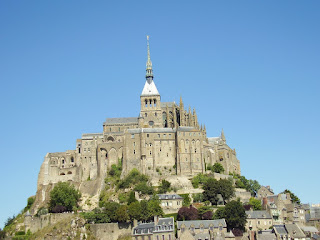
Day 2 in France took us to Mont St Michel. As you get close, you can see it rising from the fields and sea, almost floating above the land. Parking is at the end of a causeway, which takes you to the entrance. Before the causeway was built, pilgrims to Mont St Michel battled the sea and quicksand to get to the Mont. The tide has been explained to come in as quickly as a galloping horse, which would suck if you had already gotten stuck in some quicksand!


So, quick history – the abbey dates back to the 8th century. Aubert, Bishop of Avranches, was visited three times by the Archangel Michael, in a dream. St Michael commanded him to build an oratory on Mont Tombe, the outcropping of rock that is now Mont St Michel. Aubert did not do as commanded immediately, which resulted in St Michael prodding him in the forward, leaving a dent. The oratory was subsequently built, and eventually replaced by an abbey. Other buildings were added through the following centuries, and the result is what we see today.


As you stand next to it, and look up, you can see what an amazing feat of engineering it is. Brick foundations rise up from the rock, which support a small town built around the abbey. Progressing onto the Mont itself, a narrow street winds up to the abbey. It’s not hard to imagine pilgrims working their way up, stopping to buy medals depicting St Michael, and lead amulets filled with sand from the beach. Hotels, souvenir shops and restaurants flourished, just as they do today. On a hot day (and it was hot the day we visited), it can get extremely uncomfortable.
People are crowding in the street, and in the various corridors leading to wherever (this place is a maze), and heat can be stifling. Still, think of the history on which you stand. The abbey was so well fortified; it never fell to an enemy, even during the Hundred Years War.
We enjoyed an easy ride back to Bayeux, followed by dinner and a walk. The pace of life here is peaceful (at least as a tourist), which is good, because all of this is only prepping for the Big One, a day in Paris. However, before this, we have to visit the D-day Beaches, which shall be my next post.

Wednesday, July 30, 2008

Typically English Sights

On the Saturday after Megan and I arrived in the UK, we decided to go to a school fete with my life long friend Clare. Clare now has two bright and cheery young boys (William and Luke), the oldest of which (William) is preparing for his first year in school. The primary school he will be attending held a fete to raise money to build a new library.

It was a typical English summer day, sunny weather interspersed with dark clouds, cool winds and the promise of rain. Megan and I cycled from my parent’s house in Bosham over to West Ashling, admiring rolling fields and stone walls along the way.

Events at the fete were the Fancy Dress Costume competition, where the St Trinian girls made an obligatory appearance (you’ll just have to google it!); Belly Dancing Exhibition & the Tug of War (where the girls killed the boys, and the young taught the old a lesson!). Booth’s included children’s crafts, children’s obstacle course, a used bookstore, hotdogs and the all important beer tent, also serving Pimm’s.

Let me explain, Pimm’s is an English summer tradition, mostly partaken in the south, by those of us who want to hang out in the sun and get pleasantly plastered. Since we only have to ride our bicycles home, no worries! It’s made with water, fruit (lemon, orange) and some mint, with a healthy dash of Pimm’s. Naturally, the beer tent also serves ale, served at the perfect room temperature, and no, you won’t find a single cube of ice in sight.

So, there I am in the beer tent, getting my Pimm’s from Dad, and I look over to see the local Vicar (Reverend, Priest, Pastor, choose your poison!) in his summer uniform, of a black shirt, white collar and a rather nice white jacket. He is a friendly looking older gentleman, kind eyes behind grandfatherly glasses. He acknowledges me, smiles and holds up his pint of ale to take a healthy gulp, and sighs, appreciatively. It was just so perfect, and completely exemplifies my love of England, and quiet, content summer fetes.

This is also a perfect example of why you should never leave your camera at home, cause I don’t have a picture. Oh well, more to come, as I detail and organize my thoughts on our travels through Normandy. Whew, I hope you like to read!

Sunday, July 20, 2008

Compassion

Who comes up with the names of these flowers?! This rose is named 'Compassion' - seriously! Will the mere view of it fill me with compassion? Compassion for...? Can't think I really need to feel compassion for the flower, maybe the scientist who's life work was to achieve this color - needs to get out of the lab a bit more, if you ask me!

I was so busy taking the photo that I didn't take the time to smell it - just resolved that and it smells incredible - sweet, fruity, not like a rose at all, but a delicious, ripe fruit! Unfortunately, the flower no longer resides on the plant, my father just cut it and put it in a loverly crystal bowl - now I feel compassion for the flower!

Oh, yes, I am in the motherland, so expect a few more updates.
Posted by Picasa